

Federal Court Finds DOL’s H-2A Wage Rule Unlawful: What Happens Now?
August 26, 2026
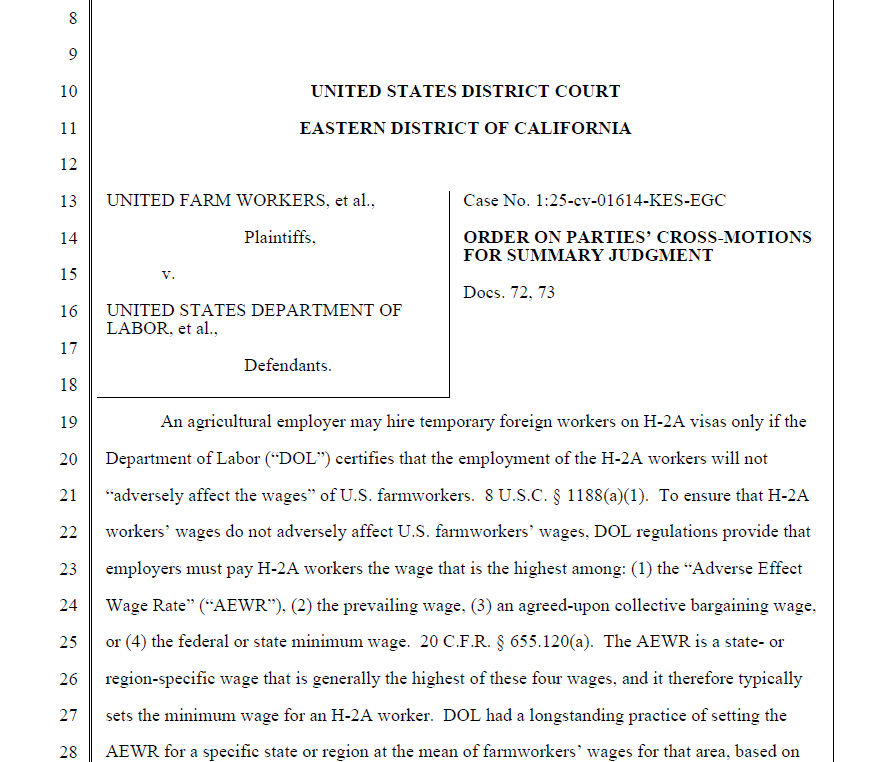
A federal district court in California has found the U.S. Department of Labor’s current H-2A Adverse Effect Wage Rate (AEWR) methodology unlawful. This decision creates another period of uncertainty for agricultural employers, but it does not immediately change the wages employers are required to pay.
The court did not vacate the current wage rule. Employers should continue to comply with the AEWRs currently in effect while DOL develops a replacement methodology. However, employers have also been put on notice that wage adjustments may eventually be owed for work performed during this interim period.
For an industry that has experienced several significant changes to H-2A wage policy in recent years, the decision adds another complication to labor planning and budgeting.
What Did the Court Find Wrong With the Rule?
The case, United Farm Workers, et al. v. U.S. Department of Labor, et al., challenged the Interim Final Rule (IFR) DOL issued in 2025. The court concluded that four parts of the rule were arbitrary and capricious. It also found that DOL did not have sufficient “good cause” to bypass the normal notice-and-comment process for most of the changes.
The court identified these problems:
The two-tier wage system. The IFR created Skill Level I and Skill Level II rates, with approximately 92 percent of H-2A jobs expected to fall into Skill Level I. The court did not say that a two-tier system is inherently unlawful, but found that DOL had not adequately justified setting Skill Level I at approximately the 17th percentile of wages and Skill Level II at the 50th percentile.
The housing adjustment. The court found several problems with reducing H-2A wages to account for employer-provided housing, including a conflict with the existing requirement that qualifying H-2A housing be provided “at no cost.” The court also criticized calculating the adjustment based on a 40-hour workweek while applying it to every hour worked, which can result in a worker effectively paying more than the calculated value of the housing.
The use of OEWS wage data. The court did not prohibit DOL from using Occupational Employment and Wage Statistics data. However, OEWS historically has not surveyed farm establishments, and its agricultural data disproportionately reflects farm labor contractor employees, who tend to have lower wages. The court found that DOL had not adequately addressed the potential downward effect of using those data for the broader agricultural workforce.
The greater-than-50-percent rule. Under the IFR, the occupation performed for the majority of the relevant workdays can determine the AEWR for the entire job. The court was concerned that this could allow substantial amounts of higher-paid work to be performed at the lower AEWR.
Does the Decision Apply Nationwide?
As a practical matter, yes. The court held the IFR itself unlawful and remanded the rule to DOL. Its order is not limited to the individual plaintiffs.
Importantly, though, the court did not immediately vacate the IFR. Doing so could leave the H-2A program without functioning AEWRs because the previous methodology relied on the USDA Farm Labor Survey, which has been discontinued. The court therefore left the current rates temporarily in place and ordered DOL to “promptly” develop a replacement methodology.
For now, employers should continue paying the currently applicable AEWR.
Can DOL Simply Finalize the IFR?
Before this decision, DOL was already planning a final rule after considering comments submitted in response to the IFR. This decision makes that path considerably more complicated.
Completing notice-and-comment rulemaking could correct the procedural problem identified by the court. It would not, however, correct the separate finding that major portions of the methodology were substantively arbitrary and capricious.
In other words, DOL cannot simply put essentially the same IFR through the proper rulemaking process and assume the problem is resolved. It will need to address the substantive problems identified by the court.
That does not mean every concept in the IFR must disappear. The court did not prohibit a two-tier wage system or the use of OEWS data. DOL could potentially retain those concepts with a different methodology and adequate support. The housing adjustment may be more difficult to retain because the court found that reducing wages based on employer-provided housing conflicts with the existing requirement that housing be provided at no cost.
What Is the Seven-Day Deadline?
DOL does not have seven days to develop a new wage rule.
Within seven days, DOL must notify state workforce agencies, employers and the public that employers using H-2A labor during this interim period may later owe wage adjustments.
DOL has separately been ordered to develop a new methodology “promptly.” The parties must report back to the court in two weeks regarding the steps DOL has taken and its anticipated timeline.
Could Employers Owe Back Wages?
Potentially.
The plaintiffs asked the court to require wage adjustments for the period between this decision and DOL’s publication of replacement AEWRs. The court did not order back wages yet because no one knows what the replacement rates will be.
Instead, employers are being put on notice that if a replacement AEWR is higher than the rate paid during this interim period, the court may later require an adjustment. That potential liability includes H-2A workers and qualifying U.S. workers in corresponding employment.
The potential backpay period begins with this court order; the court has not ordered employers to recalculate wages back to implementation of the IFR in 2025. Once DOL publishes replacement AEWRs, the parties will brief whether backpay should actually be required.
What About the SAWA Bill?
The decision also adds another dimension to the Stability for Agricultural Workers Act (SAWA), which seeks to address H-2A wage policy legislatively.
SAWA incorporates concepts similar to several features of the IFR, including skill-based wages, OEWS wage data and a housing adjustment. Its proposed housing adjustment is structured differently, including use of a daily rather than hourly adjustment, which addresses the court’s concern about the adjustment increasing when employees work more than 40 hours.
The court’s decision does not invalidate SAWA. There is an important difference between a court deciding whether DOL acted within its existing authority and Congress changing the governing law itself. Congress has considerably more ability to establish a new statutory framework.
Nevertheless, the ruling is relevant to the SAWA debate because several concepts Congress is considering are the same concepts the court has now identified as problematic under DOL’s current statutory and regulatory framework.
What Happens Next?
There is no new AEWR methodology yet and no firm date for when one will be published. DOL must first issue the required notice concerning potential wage adjustments and then report to the court about its plan for developing a replacement methodology.
For employers, the immediate requirements have not changed: continue paying the currently applicable AEWR and maintain accurate payroll and hours-worked records. But employers should also recognize that wages paid during this interim period may have to be revisited.
That creates a difficult planning environment for agricultural employers who must make H-2A staffing and budgeting decisions months in advance. The current rates remain in effect, a replacement methodology is coming, and the final financial impact of the court’s decision may not be known until after that methodology is issued.
The full court order can viewed here (will download PDF).